金屬/拓樸絕緣體凡德瓦異質結構之界面耦合的空間延伸性
Nano Lett. (2026)
Yin-Song Liao # ; Hsin-Hsien Chan # ; Ruei-Yu Wang; Han-Wei Tsai; Hsun-Ting Hsieh; Cheng-Maw Cheng; Jyh-Pin Chou * ; Meng-Kai Lin *
Finite-Depth Interfacial Coupling in Metal/Topological Insulator van der Waals Heterostructures
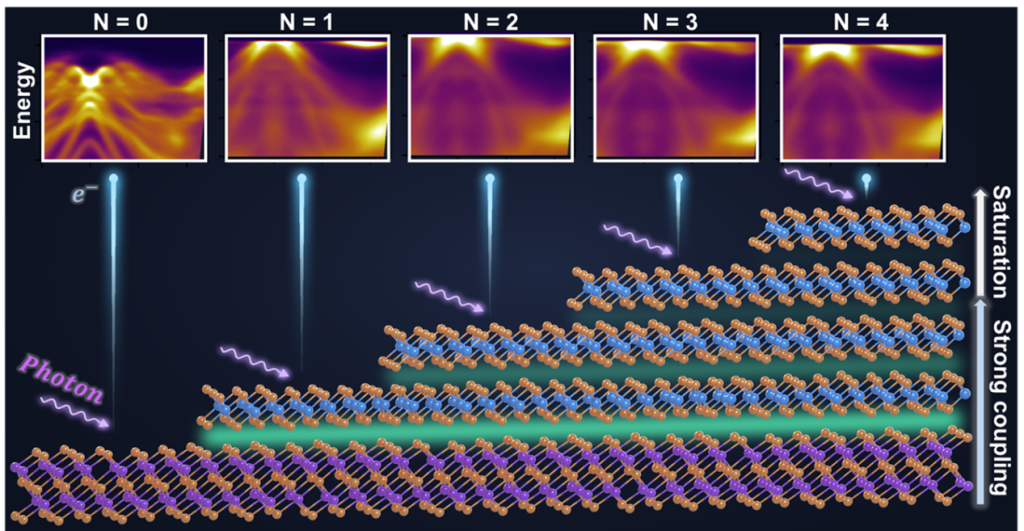
本實驗透過分子束磊晶技術,進行TiTe2/Bi2Te3異質結構之樣品製備,並研究金屬/拓樸絕緣體之凡德瓦界面耦合的空間延伸性。透過角解析光電子能譜與第一原理計算,我們發現即便是凡德瓦界面,仍可被區分為強/弱耦合區間,而在強耦合的區間中,界面的交互作用並不僅被侷限在界面上,而是可以有著約兩層薄膜厚度的空間延伸性。同時,強耦合的界面亦會造成巨大的界面電子狀態重整,因此上層材料厚度即便已超出界面耦合可影響的有效厚度,電子結構仍不會趨近於近自由懸浮的材料特性。此發現於低維度電子元件有著重要意義。
Metal/topological insulator van der Waals (vdW) heterostructures offer a platform for engineering emergent quantum states beyond isolated layers. While proximity effects in covalently bonded systems are well studied, coupling depth across vdW interfaces remains unclear. Using angle-resolved photoemission spectroscopy and first-principles calculations, we investigate the thickness dependence of TiTe2/Bi2Te3 electronic states. Despite nominally weak vdW bonding, the buried interface induces emergent bands and splitting near a band crossing, consistent with hybridization. Interface-induced features persist in the bilayer, while band evolution nearly saturates in thicker films. Even at four layers, the electronic structure does not simply recover to the intrinsic TiTe2 limit, consistent with finite-depth coupling that substantially reshapes the overlayer bands. Charge redistribution and a moiré-modulated interfacial potential contribute to this reconstruction. Finite-depth coupling may be a hallmark of strongly coupled vdW heterostructures and guide topological and quantum electronic device design.