宇宙中消失的硫,究竟去了哪裡?
ApJ, 1012, 153 (2026)
Y.-Y. Hsu, G. M. Muñoz Caro*, H. Carrascosa, A. Fuente, and Y.-J. Chen*
Photodesorption and Photochemistry of H2S Ice under Vacuum Ultraviolet Irradiation: Implications for the Missing Sulfur Reservoir in Dense Molecular Clouds
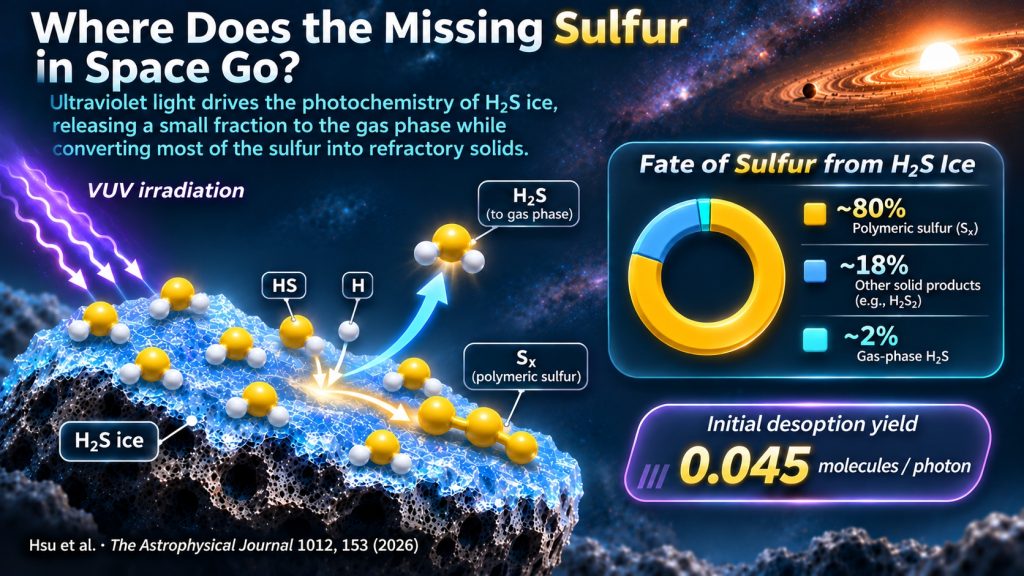
硫是參與宇宙化學演化的重要元素之一。然而,在寒冷且緻密的分子雲中,天文觀測所偵測到的氣態硫含量,卻遠低於預期的宇宙元素豐度。這些消失的硫,究竟藏在哪裡? 長久以來,覆蓋在星際塵埃表面的硫化氫(H2S)冰晶,被認為可能是儲存硫元素的重要場所。即使在外部真空紫外光難以穿透的分子雲深處,宇宙射線與分子交互作用所產生的真空紫外光,仍能驅動冰晶中的化學反應。然而,這些光子能多有效地讓 H2S 分子重新回到氣相?而留在冰晶中的硫,又會轉變成什麼物質? 在這項研究中,陳俞融教授所指導的光子作用實驗室於 13 K 的低溫環境下,利用真空紫外光(VUV)照射純 H2S 冰晶,結合紅外光譜與經過校正的質譜量測,首次直接定量測得 H2S 冰晶的光誘發脫附產率,並進一步追蹤硫元素在冰晶中的化學轉變與最終去向。 主要發現 • H2S 冰晶的初始光誘發脫附產率約為每個入射光子 0.045 個分子,並隨著冰晶的光化學演化而逐漸下降。 • 自由基再結合時所釋放的化學反應能量,是驅動 H2S 分子脫附的主要機制之一,稱為光化學脫附(photochemidesorption)。 • 在發生轉化的 H2S 所含硫元素中,僅約 2% 以 H2S 分子的形式回到氣相,約 80% 則推測轉化為難以透過紅外光譜偵測的聚合態硫(Sx)。 • 在典型的緻密分子雲環境中,真空紫外光誘發脫附與氫原子誘發的化學脫附,對氣態 H2S 的補充可能具有相近的重要性。 這項研究為什麼重要? 我們的研究顯示,真空紫外光在星際硫化學中扮演著雙重角色:一方面使少部分 H2S 分子從冰晶中脫附回到氣相,另一方面則促使大量的硫轉化為難揮發、且不易透過紅外光譜偵測的固態物質。 這樣的光化學反應途徑,為長久以來困擾天文學家的「硫元素缺失之謎」提供了一種可能的解釋,也為星際化學模型提供重要的實驗依據,幫助我們進一步了解硫元素在恆星與行星形成早期的分布、儲存及化學演化。
Sulfur is an important element in the chemical evolution of the universe. Yet in cold, dense molecular clouds, the amount of sulfur detected in the gas phase is far below its expected cosmic abundance. Where is the missing sulfur hiding? Hydrogen sulfide (H2S) ice on interstellar dust grains has long been considered a potential sulfur reservoir. Even deep inside molecular clouds, where external ultraviolet radiation is strongly attenuated, ultraviolet photons generated through cosmic-ray interactions can still drive chemical reactions in these icy environments. But how efficiently do these photons release H2S back into the gas phase, and what happens to the sulfur that remains in the ice? In this study, the PhotoProcessing Laboratory, led by Professor Asper Chen, exposed pure H2S ice to vacuum ultraviolet (VUV) irradiation at a cryogenic temperature of 13 K. By combining infrared spectroscopy with calibrated mass spectrometric measurements, the research team directly quantified the photodesorption yield of H2S ice for the first time and further traced the chemical evolution and ultimate fate of sulfur within the ice. Key findings • The initial H2S desorption yield reaches approximately 0.045 molecules per incident photon and decreases as the ice undergoes photochemical processing. • Photochemidesorption, driven by the energy released during radical recombination, appears to be the dominant desorption mechanism. • Only about 2% of the sulfur released from the original H2S molecules returns to the gas phase as H2S, while approximately 80% is inferred to form infrared-inactive polymeric sulfur (Sx). • Under typical dense molecular cloud conditions, VUV-induced desorption and H-atom-induced chemical desorption may contribute comparably to the gas-phase abundance of H2S. Why it matters Our results suggest that ultraviolet radiation plays a dual role in interstellar sulfur chemistry: it releases a small fraction of H₂S into the gas phase while transforming much of the sulfur into refractory species that are difficult to detect through infrared spectroscopy. This photochemical pathway offers a plausible explanation for part of the missing sulfur in dense molecular clouds. It also provides essential laboratory constraints for astrochemical models, helping us better understand how sulfur is redistributed and preserved during the early stages of star and planet formation.