CO 光譜能告訴我們星際冰晶的形成故事嗎?
ApJ, 1003, 3 (2026)
R. Aslam, C.-Y. Lee, Y.-H. Chiu, C. Cecchi-Pestellini*, A. Ciaravella, A. Jiménez-Escobar, A. Mangione, & Y.-J. Chen*
CO Line Profiles in Accreting Ices
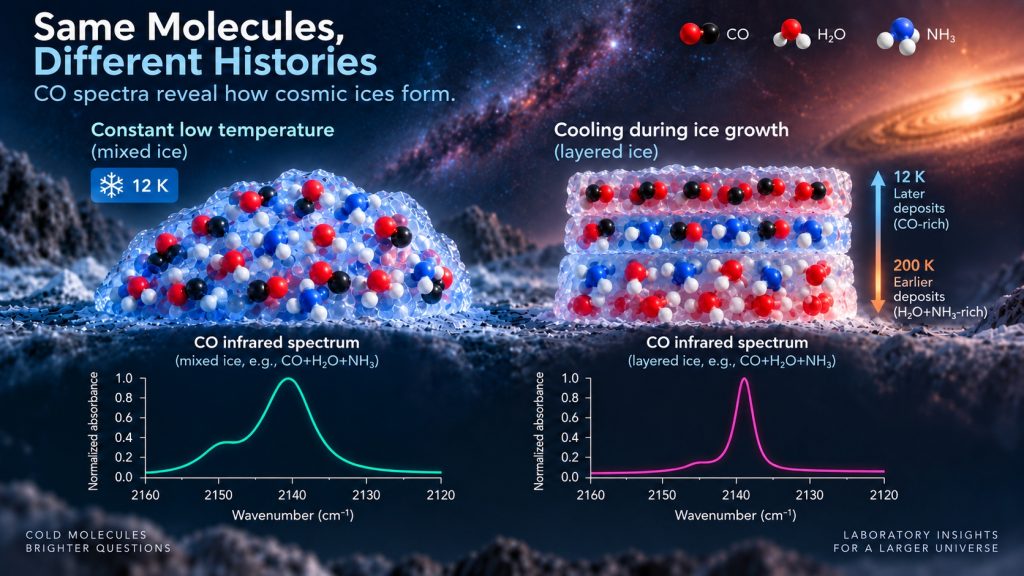
在寒冷的宇宙環境中,各種分子會陸續附著在塵埃表面,逐漸形成冰晶外殼。這些冰晶並不是單一、均勻的結構,而會隨著周遭溫度、化學組成與形成歷程不同,呈現出不同的排列方式與局部環境。這些差異,也會反映在它們的紅外光譜上。 其中,CO 是一個特別敏感的「探針」。它的紅外吸收特徵,會隨著周圍有哪些分子、冰晶是混合還是分層,以及形成時經歷過什麼樣的溫度變化而改變。問題是,過去許多實驗都在固定低溫下製作冰晶,但真實宇宙中的塵埃,往往是在持續降溫的過程中逐步累積分子。那麼,CO 的光譜是否能幫助我們看出這些冰晶是如何形成與演化的? 在這項研究中,我們製作含有 CO、H2O、NH3、CH4、CO2 與 CH3OH 的冰晶,並比較兩種形成方式:一種是在固定 12 K 下沉積,另一種則是在溫度從 200 K 降到 12 K 的過程中持續沉積。我們再利用這些實驗光譜建立 CO 的特徵資料庫,並拿來分析 JWST 對兩條分子雲視線與一個原行星盤的觀測結果。 主要發現 • CO 的光譜形狀可以反映冰晶中的化學環境與結構。 • 降溫過程中形成的冰晶較容易呈現分層結構,固定低溫沉積則較容易形成混合冰晶。 • JWST 光譜顯示,分子雲中的 CO 主要存在於分層環境,而原行星盤中的冰晶則更複雜,也經歷了更多後續重整。 這項研究為什麼重要? 這項研究顯示,CO 的紅外吸收帶不只是辨認分子的「光譜指紋」,也可以成為讀取星際冰晶形成歷史與內部結構的線索。透過把實驗室光譜直接與 JWST 觀測連結,科學家可以更進一步了解冰晶中的分子如何排列,以及這些結構如何從相對平靜的分子雲,演變到更動態、受熱與擾動影響的原行星盤環境。
In the cold regions of space, molecules freeze onto dust grains and gradually build up icy mantles. These ices are not all alike: their molecular composition, structure, and thermal history can vary with their environment. Remarkably, these differences can leave fingerprints in their infrared spectra. Among these molecules, CO is a particularly sensitive probe. Its infrared absorption profile changes depending on the molecules surrounding it and how the ice is structured. But most laboratory experiments grow ices at a fixed low temperature, while real cosmic dust grains cool as molecules gradually accumulate. Can the CO spectrum reveal how these ices actually formed and evolved? In this study, we produced CO-containing ices with H2O, NH3, CH4, CO2, and CH3OH using two approaches: deposition at a constant 12 K and deposition while cooling from 200 to 12 K. We then built a library of CO spectral components and used it to analyze JWST observations of two molecular cloud sight lines and one protoplanetary disk. Key findings • The CO spectral profile reveals both the chemical environment and structure of the ice. • Cooling during ice growth produced more layered structures, while constant-temperature deposition favored mixed ices. • JWST spectra indicate layered CO environments in molecular clouds, but more complex and reprocessed ices in the protoplanetary disk. Why it matters These results show that the CO absorption band is more than a molecular fingerprint—it can act as a window into the history and architecture of cosmic ices. By connecting laboratory spectra directly with JWST observations, this approach helps scientists identify how molecules are arranged within icy mantles and how those structures change from relatively quiet molecular clouds to more dynamically evolving protoplanetary disks.