How Carbonaceous Dust Shapes CO₂Chemistry in Space?
ApJ, 1004, 181 (2026)
C.-Y. Lee*, K.-J. Chuang*, Y.-Y. Hsu, C. Jäger, Th. Henning, & Y.-J. Chen*
Extreme-ultraviolet Photochemistry in Water-covered Carbonaceous Dust Analogs: Effects of Dust Thickness and Hydrogen Content
宇宙中散布著大量微小的富碳塵埃。別看它們尺寸微小,表面卻像是一座座迷你化學實驗室:周圍氣體中的分子可以附著在塵埃上,並在這裡展開各種化學反應。 過去研究已發現,當覆蓋水冰的碳質塵埃受到X射線或紫外光照射時,可以形成 CO2。但一顆塵埃「本身是什麼樣子」,是否也會影響 CO2 的形成?特別是塵埃的厚度與含氫程度,扮演了什麼角色? 在這項研究中,我們在實驗室製作不同厚度與含氫程度的碳質塵埃類比物,在僅 15 K 的低溫下覆上一層水冰,再以極紫外光照射,模擬這類在原行星盤環境中特別重要的高能輻射過程。 主要發現 • 塵埃厚度越厚,形成的 CO2 越多。 • 含氫的碳質塵埃具有更高的反應性。 • 極紫外光照射還會改變碳的結構,促使 C≡C 三鍵的形成。 這項研究為什麼重要? 研究顯示,碳質塵埃並非只是讓冰晶附著的「背景舞台」,塵埃本身的厚度與含氫程度,也會左右冰晶與塵埃交界處發生的化學反應。這些結果讓我們更進一步了解,在孕育行星系統的原行星盤中,CO2 與富碳物質可能如何受到高能輻射影響,並隨著環境持續演化。
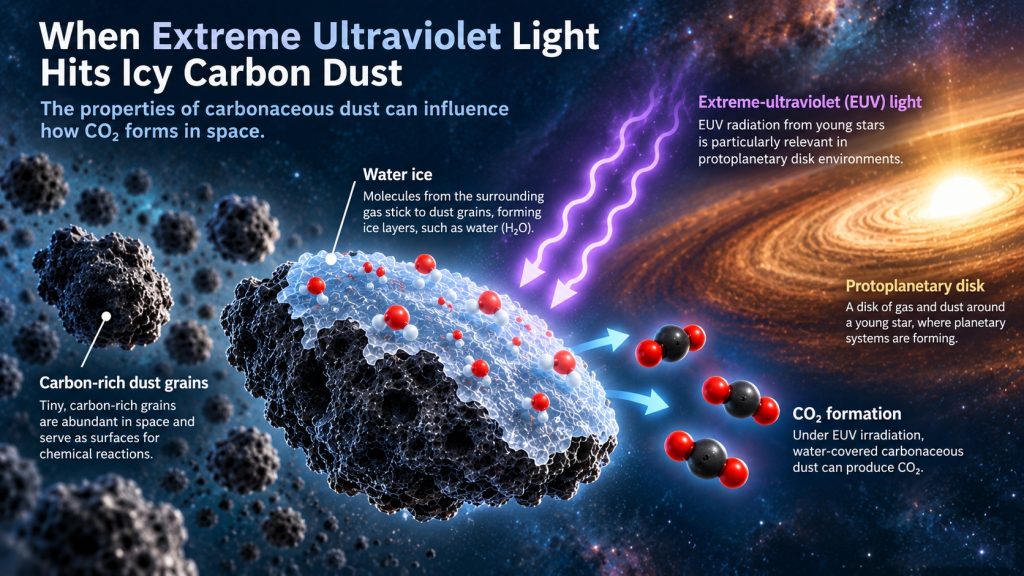
How Carbonaceous Dust Shapes CO₂ Chemistry in Space? Space contains enormous amounts of tiny carbon-rich dust grains. Their surfaces can act as miniature chemical laboratories, where molecules from the surrounding gas stick and react. Scientists know that radiation such as X-rays and ultraviolet light can cause water-covered carbon dust to produce CO2. But it was unclear how this process depends on the properties of the dust itself—especially its thickness and hydrogen content. In this study, we used laboratory-made carbonaceous dust analogs with different thicknesses and hydrogen contents, covered them with water ice at 15 K, and exposed them to extreme-ultraviolet (EUV) radiation, which is particularly relevant in protoplanetary disk environments. Key findings • Thicker dust produced more CO2. • Hydrogen-rich dust was more reactive. • EUV irradiation also changed the carbon structure, producing C≡C bonds. Why it matters These results show that carbonaceous dust is not just a passive surface for ice to sit on. Its thickness and hydrogen content can directly influence chemistry at the dust–ice interface. The findings may help scientists better understand how CO2 and carbon-rich materials evolve in irradiated environments such as protoplanetary disks, where planetary systems are forming.