How Does Carbonaceous Dust Influence CO₂ Formation in Space?
A&A, 712, L16 (2026)
Y.-H. Chiu, T. Suhasaria*, C. Jäger, C.-Y. Lee, K.-J. Chuang, Th. Henning, and Y.-J. Chen*
Molecule-specific diffusion and desorption of interstellar ices on carbonaceous dust
碳質塵埃如何影響太空中的 CO2 形成? 在寒冷的宇宙環境中,星際塵埃表面常覆蓋著一層冰晶,其中包含 CO、CO2 和 H2O 等分子。這些冰晶保存了重要的揮發性物質,也參與恆星與行星形成過程中的化學演化。 在實驗室裡,科學家經常利用平滑、化學性質穩定的表面來研究星際冰晶,並假設當冰晶層夠厚時,底下的表面就不再重要。然而,真實的星際塵埃其實具有高度多孔的結構。那麼,塵埃表面的特性,是否仍會影響覆蓋在上面的冰晶? 在這項研究中,我們將 CO、CO2 和 H2O 冰晶分別沉積在平滑的 CaF2 表面,以及實驗室製作的多孔碳質塵埃類比物上,並在 15 K 的低溫下利用紅外光譜觀察冰晶的特徵,再逐步升溫追蹤它們的變化與脫附行為。 主要發現 • 碳質塵埃改變了 CO 和 CO2 冰晶的紅外光譜特徵。 • CO 和 CO2 會擴散進入多孔塵埃中,使脫附延後。 • 相較之下,H2O 冰晶受到塵埃表面的影響較小。 這項研究為什麼重要? 我們的研究顯示,星際塵埃並不只是承載冰晶的「背景舞台」。它的多孔結構會影響分子的排列方式、我們看到的紅外光譜,以及分子何時從冰晶中脫附回到氣相。因此,在解讀 JWST 等天文望遠鏡觀測到的星際冰晶光譜時,塵埃與冰晶之間的交互作用也是不可忽略的一環。這些結果也有助於建立更貼近真實星際環境的化學模型,進一步了解恆星與行星形成環境中的物質演化。
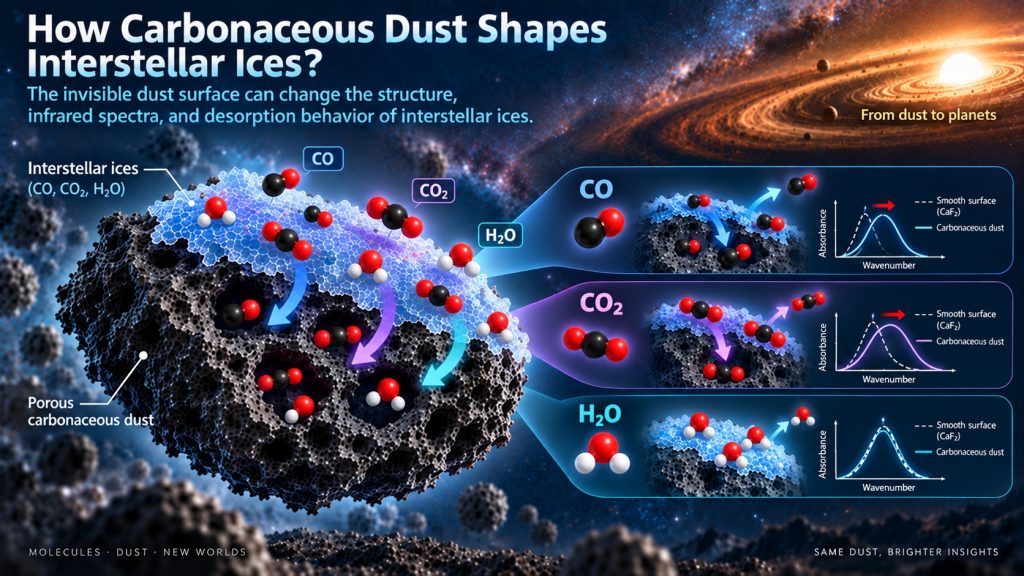
How Does Carbonaceous Dust Influence CO₂ Formation in Space? Interstellar dust grains in cold regions of space are often covered by icy mantles containing molecules such as CO, CO2, and H2O. These ices preserve important volatile materials and play a key role in the chemical evolution of star- and planet-forming environments. Laboratory studies often grow these ices on smooth, inert surfaces, assuming that the underlying surface becomes unimportant once the ice is thick enough. But real interstellar dust grains are highly porous. Does the dust surface still affect the ice above it? In this study, we deposited CO, CO2, and H2O ices at 15 K on either a smooth CaF2 surface or laboratory-made porous carbonaceous dust analogs, and monitored their infrared spectra and thermal behavior as the samples were warmed. Key findings • Carbonaceous dust changed the infrared signatures of CO and CO2. • CO and CO2 diffused into the porous dust, delaying their desorption. • H2O was much less affected by the underlying dust surface. Why it matters These results show that interstellar dust is not simply a passive surface beneath the ice. Its porous structure can influence how molecules are arranged, how their infrared signatures appear, and when they return to the gas phase. Accounting for these dust–ice interactions is therefore important for interpreting astronomical ice observations, including those from JWST, and for improving models of chemical evolution in star- and planet-forming environments.