Moiré-Induced Electronic Reconstruction in van der Waals Heterobilayer PtSe2/PtTe2
ACS Nano
Yin-Song Liao, Ruei-Yu Wang, Han-Wei Tsai, Guan-Hao Chen, Hsin-Hsien Chan, Hsun-Ting Hsieh, Cheng-Maw Cheng, Chun-Liang Lin, Meng-Kai Lin,* and Jyh-Pin Chou
Moiré-Induced Electronic Reconstruction in van der Waals Heterobilayer PtSe2/PtTe2
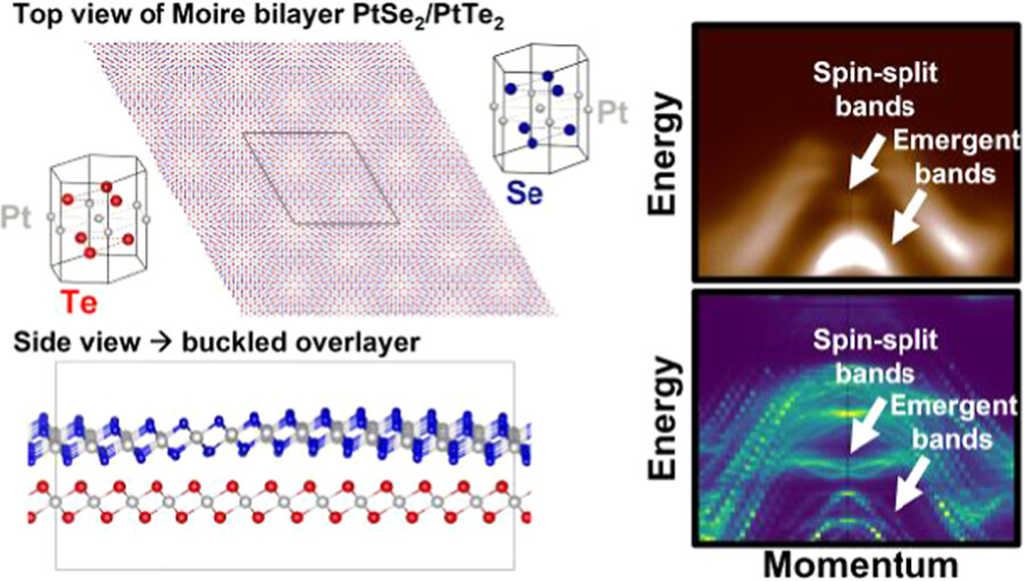
凡德瓦異質結構,由於材料可逼近原子尺度,因此在凝態物理學群極受注目。由於界面間沒有鍵結,凡德瓦異質結構界面間仍會透過如莫瑞週期調製、電荷重新分配、以及電子軌域的混層導致能帶結構的變化以及調製界面耦合的強弱。於本研究中,林孟凱的團隊透過分子束磊晶技術成功成長出單層PtSe2/PtTe2異質接面,並運用角解析光電子能譜技術證實了此凡德瓦異質接面的耦合特性。除實驗發現,林孟凱的實驗團隊亦協同台灣大學周至品教授團隊進行第一原理計算,研究更深入的物理機制。藉由實驗及理論比對,得知此異質結構會透過界面交互作用,使得PtSe2產生曲折而破壞晶體對稱性,進一步導致自旋能帶分裂;此外,莫瑞週期中特定的局域電子態,會產生靠近費米能階的「平帶」結構,意味著部分的價電子產生了局域性。此研究結果解釋了凡德瓦二維系統的界面交互作用機制,並說明了界面交互作用如何影響能帶結構的分布,提供了凡德瓦二維系統在低維度下的應用可能性。
van der Waals heterostructures composed of a few atomic layers have attracted significant attention in the condensed matter physics community. Although interlayer bonding is weak, effects such as moiré modulation, charge redistribution, and electronic hybridization can substantially modify the band structure and interlayer coupling. In this work, we investigate heterostructures composed of few-layer PtSe2 and PtTe2 by using first-principles calculations implemented within density functional theory (DFT) and angle-resolved photoemission spectroscopy (ARPES). While both materials are Dirac semimetals in the bulk form, they undergo a transition to semiconducting states in the few-layer limit. These heterostructures allow systematic examination of how dimensional confinement and interfacial interactions influence band structure and interlayer coupling. Our combined ARPES measurements and DFT calculations indicate the presence of electronic hybridization at the interface. The interlayer coupling in PtSe2/PtTe2 is associated with flat-band features and valence-band splitting induced by both inversion symmetry breaking and spin–orbit coupling. Furthermore, the local density of states indicates metallic behavior at the MM site while it remains semiconducting at MX and XX sites with the band gap of 0.40 and 0.25 eV, respectively. Further analysis shows that the electronic hybridization and charge transfer between PtSe2 and PtTe2 are sensitive to the interlayer distance, which is consistent with moiré characteristics. These results highlight how interfacial interactions govern the electronic properties of vdW heterostructures.